
| Netra OCR 1 | Tesseract | Surya | Qwen2.5-VL | DeepSeek-OCR | |
|---|---|---|---|---|---|
| KHOB | 1.0 | 5.1 | 14.5 | 89.2 | 33.2 |
| Legal Document | 5.3 | 41.8 | 51.2 | 84.6 | 44.2 |
| Printed Words | 3.0 | 8.0 | 28.4 | 98.6 | 69.8 |
Abstract#
Netra OCR 1 is a 17M-parameter model designed to process variable-length text-line images with high accuracy and low latency. Trained from scratch on a dataset of 1.3M bilingual (Khmer and English) text-line images, the model uses an encoder-decoder architecture. The vision encoder integrates a Squeeze-and-Excitation (SE) network with a Transformer encoder to extract spatial features, while the decoder uses a standard Transformer architecture for autoregressive text generation.
To accommodate the distinct orthographic structures of the two languages, we implement a hybrid tokenization strategy: English text is processed at the character level, whereas Khmer text uses a mixture of character-level and character-cluster (KCC).
Datasets#
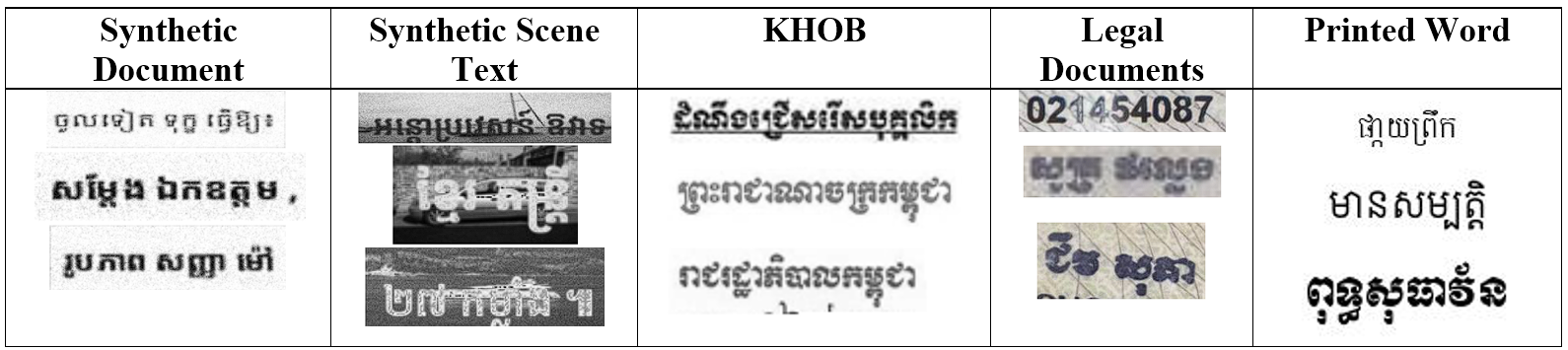
The model was trained entirely on synthetic data and evaluated on real-world and synthetic datasets.
Training data (synthetic)#
We generated 200,000 synthetic text-line images across 11 typographical fonts, and combined them with two external open-source datasets — SoyVitou/KhmerSynthetic1M and seanghay/khmer-hanuman-100k — for 1.3M training images in total.
| Dataset | Count | Source |
|---|---|---|
| Custom document text | 100,000 | Pillow + Khmer corpus, with erosion, noise, and perspective distortion |
| Custom scene text | 100,000 | SynthTIGER + Stanford BG, with rotation, blur, and realistic backgrounds |
| KhmerSynthetic1M | 1,000,000 | External (SoyVitou) |
| khmer-hanuman-100k | 100,000 | External (seanghay) |
Evaluation data (real-world + synthetic)#
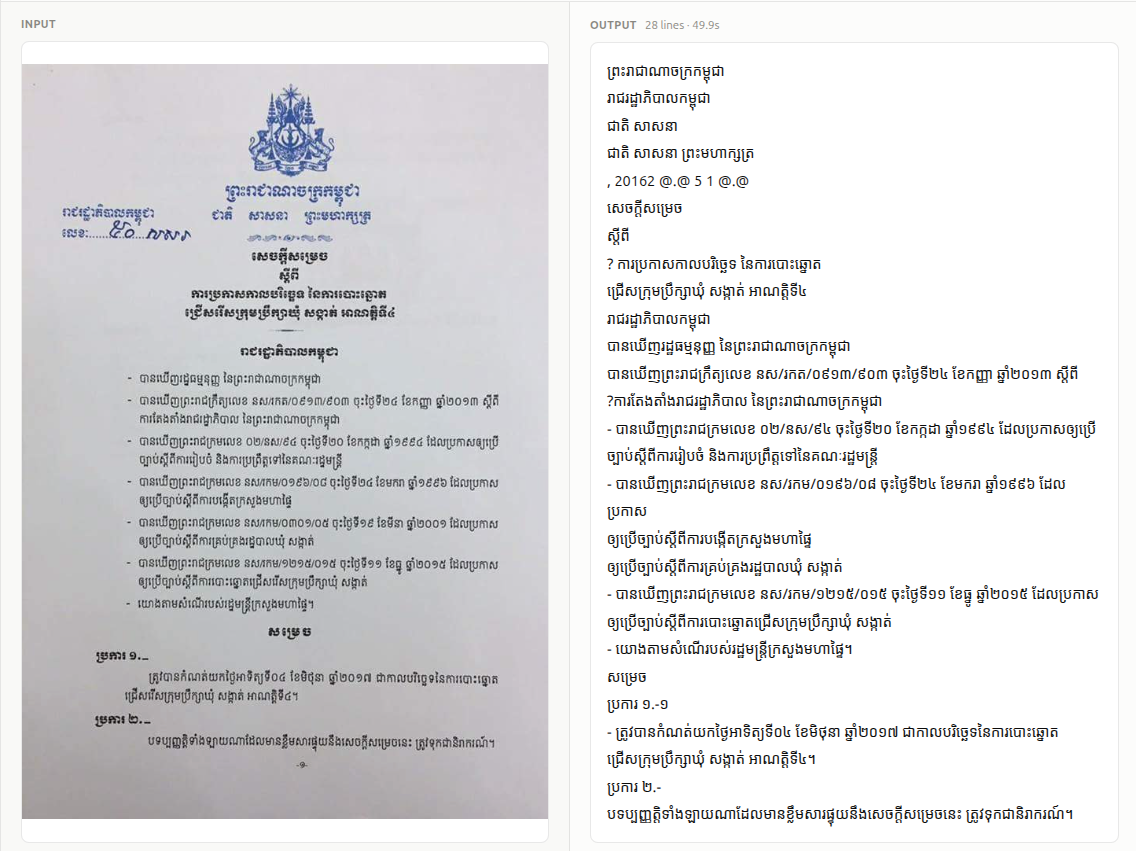
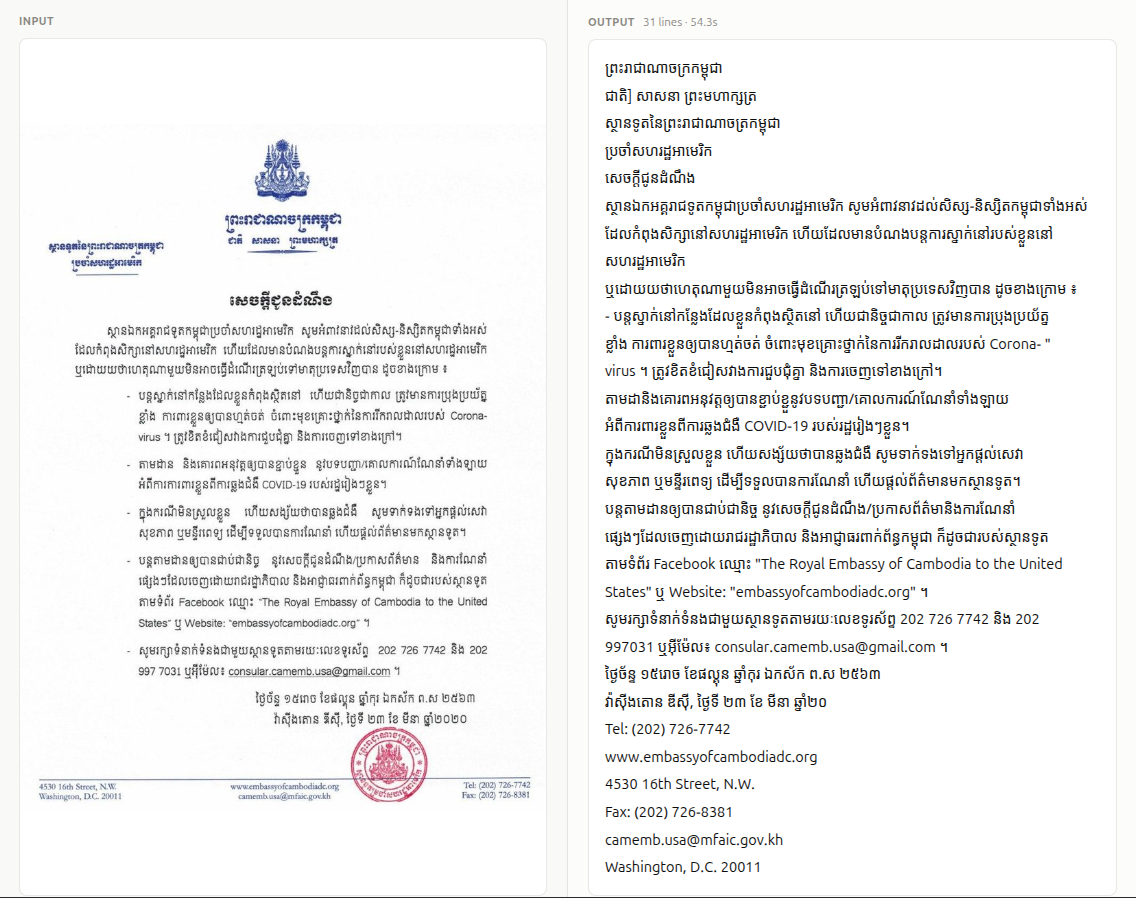
Evaluation combines the public Khmer OCR Benchmark (KHOB) with a proprietary, custom-annotated set of smartphone-captured legal documents — birth certificates, diplomas, and national ID cards — to test real-world applicability, plus a synthetic printed-word set to assess short-sequence recognition specifically.
| Dataset | Type | Size | Description |
|---|---|---|---|
| KHOB | Real | 325 | Standard benchmark, clean backgrounds but compression artifacts. |
| Legal Document | Real | 227 | High variation in degradation, illumination, and distortion. |
| Printed Words | Synthetic | 1,000 | Short, isolated words in 10 different fonts. |
Architecture#
Netra OCR 1 uses a "chunk-and-merge" strategy to handle variable-length text-lines without aggressive resizing: input images are resized to a fixed height of 48px, then split into overlapping 48×100px chunks (16px overlap).
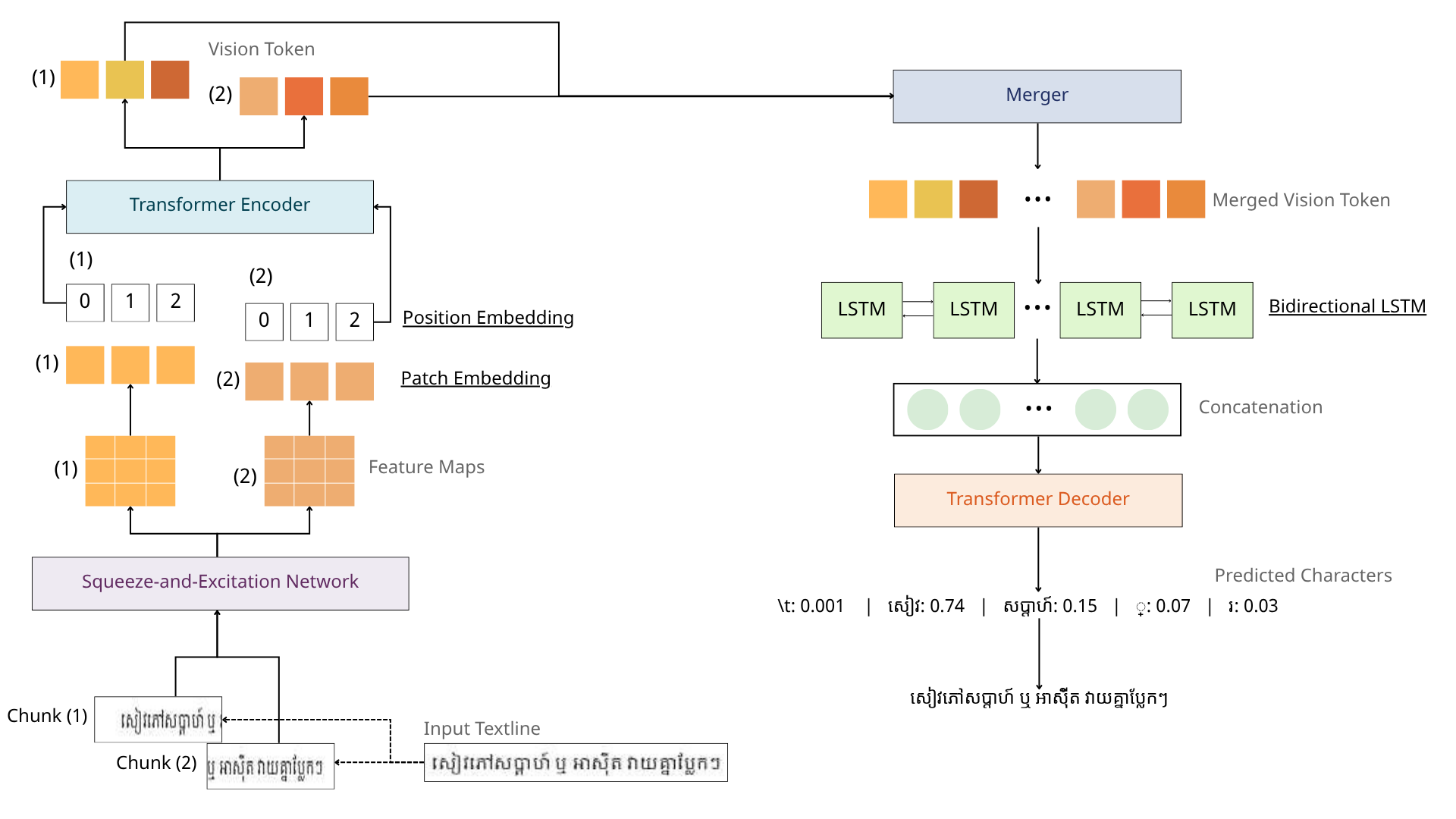
Each chunk passes through a Squeeze-and-Excitation backbone — five VGG-style convolutional blocks with height-only pooling in later stages, so the width axis (where character order lives) is preserved. A 1D SE module then recalibrates the feature maps per horizontal column rather than globally, letting the network weight noisy channels independently at each position along the line.
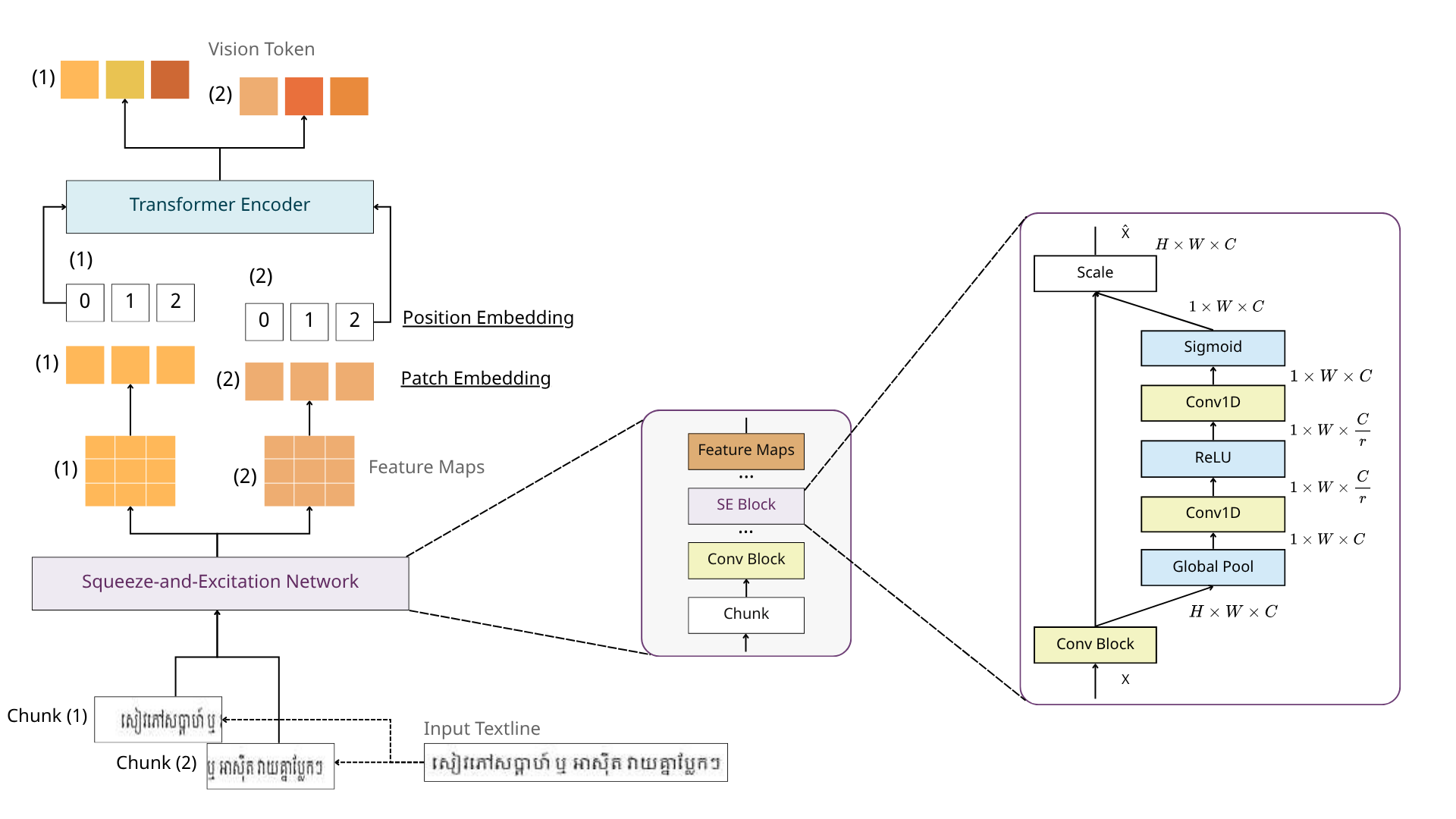
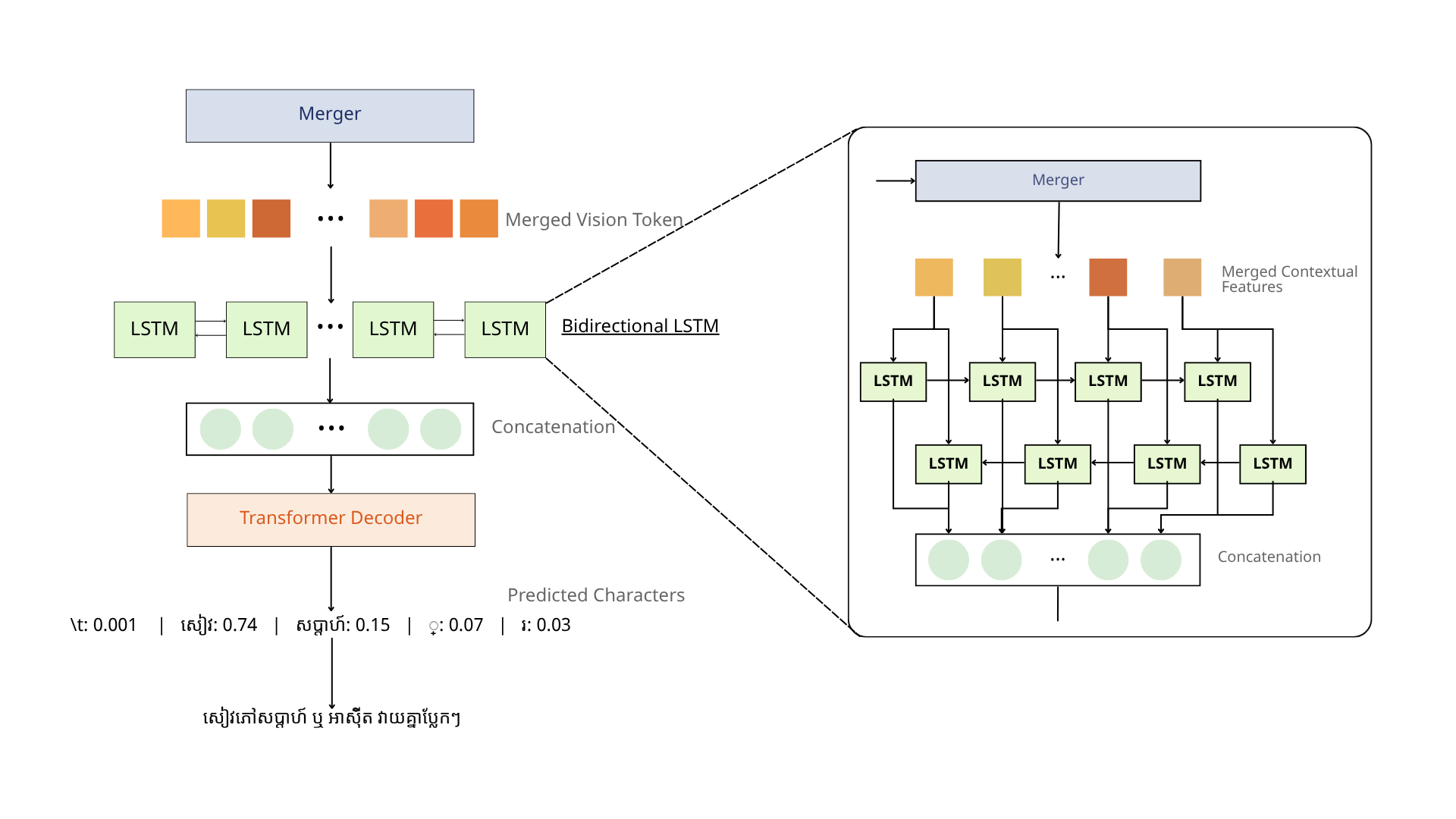
The resulting feature map is projected into a sequence of patch embeddings and passed through a Transformer encoder, producing per-chunk "vision tokens." Because a line is split into overlapping chunks encoded independently, the seams between them can be inconsistent — so after merging all chunks back into one sequence, a bidirectional LSTM smooths the representation across chunk boundaries before a standard autoregressive Transformer decoder generates the output character-cluster sequence.
Results#
Netra-OCR was benchmarked against five models, including vision-language models such as Qwen2.5-VL (3B) and DeepSeek-OCR (3B) fine-tuned on the same training set, measured by Character Error Rate (CER, lower is better) across KHOB, legal documents, and printed-word benchmarks. The full scores are in Table 1 at the top of this post.
References#
-
An Image is Worth 16x16 Words: Transformers for Image Recognition at Scale
Alexey Dosovitskiy, Lucas Beyer, Alexander Kolesnikov, et al.
ICLR 2021.
arXiv:2010.11929 -
TrOCR: Transformer-based Optical Character Recognition with Pre-trained Models
Minghao Li, Tengchao Lv, Lei Cui, Yijuan Lu, Dinei Florencio, Cha Zhang, Zhoujun Li, Furu Wei.
AAAI 2023.
arXiv:2109.10282 -
Toward a Low-Resource Non-Latin-Complete Baseline: An Exploration of Khmer Optical Character Recognition
R. Buoy, M. Iwamura, S. Srun and K. Kise.
IEEE Access, vol. 11, pp. 128044-128060, 2023.
DOI: 10.1109/ACCESS.2023.3332361 -
Balraj98. (2018). Stanford background dataset [Data set]. Kaggle. https://www.kaggle.com/datasets/balraj98/stanford-background-dataset
-
EKYC Solutions. (n.d.). Khmer OCR benchmark dataset (KHOB) [Data set]. GitHub. https://github.com/EKYCSolutions/khmer-ocr-benchmark-dataset
-
Em, H., Valy, D., Gosselin, B., & Kong, P. (2024). Khmer text recognition dataset [Data set]. Kaggle. https://www.kaggle.com/datasets/emhengly/khmer-text-recognition-dataset
-
Squeeze-and-Excitation Networks
Jie Hu, Li Shen, and Gang Sun.
CVPR 2018.
arXiv:1709.01507 -
Bidirectional Recurrent Neural Networks
Mike Schuster and Kuldip K. Paliwal.
IEEE Transactions on Signal Processing, 1997.
DOI: 10.1109/78.650093